

IVA vs IVR: What’s the Difference and Which Is Right for Your Call Center?
 Convoso
IVR (Interactive Voice Response) uses menu-based prompts to route calls and handle simple tasks, while IVA (Intelligent Virtual Agent) uses AI and natural language to carry on real-time conversations. IVR is best for basic inbound routing and self service, while IVA supports more complex inbound and outbound workflows like lead qualification, compliance, and personalized engagement. The right choice depends on your goals: IVR for simple, cost efficient automation; IVA for higher ROI, outbound performance, and stronger compliance.
Table of Contents
What is IVR?
What is IVA?
IVA vs IVR: Key differences (comparison chart)
Compliance differences between IVR and IVA for outbound teams
How Convoso uses automation to improve outbound sales
IVA vs IVR: Which is best for your call center?
FAQ: IVR, IVA, and call center automation
Modern call centers are under pressure to do it all: hit performance goals, stay compliant, and the constant need to meet rising expectations on shrinking budgets.
For years, IVR has been a reliable way to streamline inbound call routing and automate routine tasks. Now, newer AI-powered tools like IVA are adding more flexibility, enabling real-time conversations for both inbound and outbound engagement.
Both technologies offer major advantages, but the best choice depends on your goals. So, what’s the real difference between IVR and IVA? And which one helps your team drive better results?
Let’s break it down.
What is IVR?
IVR—short for Interactive Voice Response—is what you get when you call a business and hear, “Press 1 for sales, press 2 for support.” It’s menu-based, usually driven by keypad input or basic voice commands, and has remained a go-to solution in call centers for decades thanks to its reliability.
Common use cases:
Customer service: Routing calls, providing recorded answers, handling simple self service options like checking a balance
Outbound sales: Confirming the reason for the callback (“Press 1 for a quote”), collecting basic inputs like appointment confirmations, language preferences, or zip codes
Inbound sales: Directing to sales reps, sharing product info via menu options
Why teams still use it:
It’s inexpensive and easy to set up
Works 24/7 without needing live agents
Scales well for basic routing tasks
Where it falls short:
Long menus and robotic prompts frustrate callers
Limited flexibility for handling complex or dynamic conversations
Limited to simple outbound tasks (can’t handle lead qualification or complex compliance)
In many industries—like banking, telecom, and utilities—IVR still holds its own. According to McKinsey, more than 50% of callers are actually using IVRs meaningfully in those spaces.
While traditional IVR remains widely used, Convoso’s IVR modernizes the experience by making it frictionless and geared toward getting high intent leads to the right rep fast. Using clean, no-friction DTMF inputs, it connects directly to skills-based queues and campaign logic.
And because it syncs those inputs with real-time lead and campaign data, agents receive context rich details—like caller ID, campaign source, or language preference—right in the interface. That means less ramp up time, smoother conversations, and more closed deals.
If your focus is outbound sales, lead qualification, or compliance heavy campaigns, traditional IVR may struggle to keep up with what you need.
>>> Related: Convoso’s breakdown of connection rate vs contact rate shows why static call flows often fail to maximize sales opportunities.
What is IVA?
Intelligent Virtual Agents (IVA) are AI-powered systems that add a conversational layer to call handling. With speech recognition, natural language processing (NLP), and real-time data, they let callers speak naturally and get answers or actions completed without navigating a menu.
Use cases:
Customer service: Triaging support calls, answering FAQs, resolving simple issues without an agent
Outbound sales: Qualifying leads, setting appointments, capturing consent before transfer
Inbound sales: Handling product inquiries, sharing pricing or availability, routing high intent call backs to reps
Why teams are turning to IVA:
Handles natural, two-way conversations
Delivers personalized experiences at scale
Enables real-time CRM-driven personalization
Can support complex inbound and outbound strategies
A few tradeoffs:
Setup is more complex than IVR
Needs clean, structured data to perform well
Higher upfront cost but stronger ROI
This shift toward AI-driven automation is already visible across modern sales organizations. The real value is taking repeatable tasks off agents’ plates so the team can focus where it matters most.
“Why not let the computers do the repetitive work and then transfer the call to humans to go over more complex details? We have to get rid of all these tedious tasks that people are doing. It’s a waste of their time and skills.”
— Bobby Hakimi, Convoso Chief Product Officer and Co-Founder
>>>Related: Learn the 10 Call Center IVR Best Practices for Sales Teams
IVA vs IVR: Key differences (comparison chart)
Choosing between IVR and IVA means finding the right fit for your team’s goals. Here’s how they stack up:
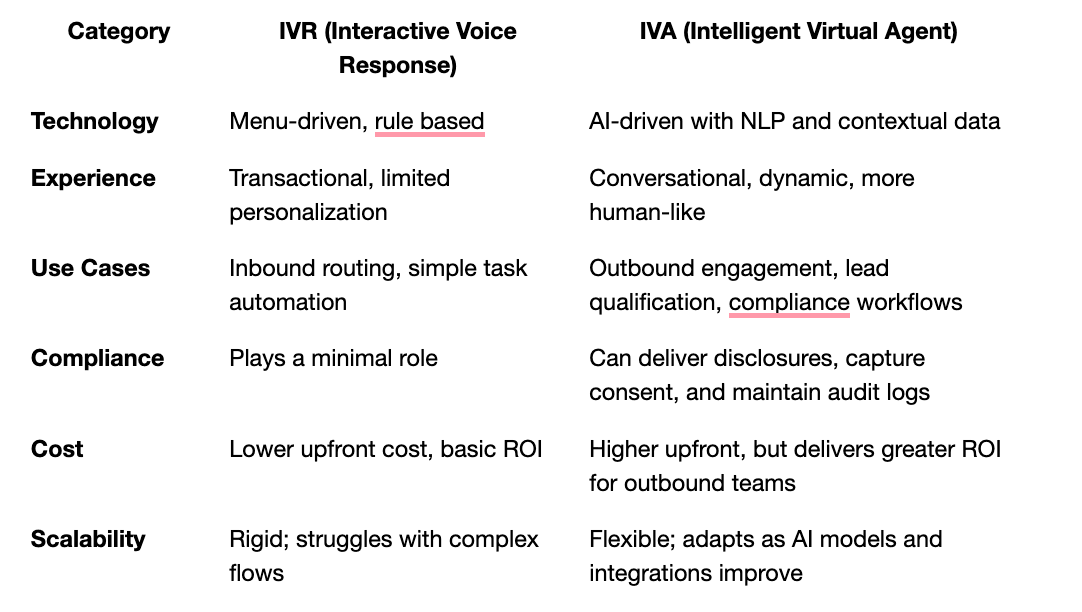
Compliance note: Unlike IVR, an IVA can be trained to deliver required disclosures, adapt to state-specific rules in real time, and log every consent. It’s a powerful asset for sales teams that need to stay compliant without slowing down.
For compliance first outbound programs, learn how Convoso’s StateTracker™ automatically enforces calling restrictions and pairs well with intelligent automation.
Compliance differences between IVR and IVA for outbound teams
This is where many contact centers underestimate the gap. IVR was designed for inbound routing, not outbound sales compliance. But in today’s environment—where new consent laws and TCPA enforcement create serious risks—compliance must be baked into every interaction.
Here’s where IVA gives you the edge:
Delivers required disclosures and logs consent in real time
Automates scripts to reduce missed or incorrect compliance language
Can track and store every consent interaction for audit readiness
More teams are now adopting ethical AI practices as part of this shift, letting customers know upfront that they are speaking with an AI assistant. That kind of upfront disclosure helps build trust while meeting compliance expectations.
Convoso emphasizes compliance across its platform, combining call recording, consent management, and DID reputation management with Convoso IgniteTM. Adding AI-powered automation to this stack means you can improve efficiency while staying legally defensible.
>>> Related: AI in Insurance Call Centers: Balancing Compliance, Consent, and Performance
Get monthly updates on the latest compliance news impacting contact centers
How Convoso uses smart automation to improve outbound sales
Convoso was built with outbound sales at its core, not retrofitted for it. From the start, the platform was designed to support the high speed, high volume demands of revenue teams focused on performance and compliance.
Convoso brings intelligent automation to key parts of the outbound stack—like lead prequalification, campaign management, number reputation management, dynamic scripting, compliance workflows, and call routing—so sales teams can move faster and convert more leads without cutting corners.
Here’s what Convoso provides to power modern sales operations:
Convoso Ignite™ DID lifecycle management: An AI-powered system built into the Convoso platform that gets more calls answered and reduces cost per acquisition. It chooses the optimal number for every call in real time, automatically purchases and manages numbers, and uses intelligent number health and reputation scoring to maintain peak call performance.
Answering machine detection (AMD): Filters out voicemails with up to 97% accuracy so agents only spend time on real conversations—boosting morale and contact rates (learn how AMD boosts contact rates).
StateTracker™: Applies calling rules for each lead in real time—including state-specific restrictions, do-not-call lists, holidays, and emergency bans—so teams can stay compliant without manual effort.
Voso.ai: Handles early stage interactions like appointment setting, lead qualification, and after hours engagement, freeing up reps for more complex conversations. Or in Nima Hakimi’s words, “Voso.ai will magnify our customers’ reach, fast track more productive conversations, and reduce their cost per acquisition.”
Dynamic scripting: Surfaces the right disclosures, license details, and messaging in real time—based on lead data, campaign type, and state-specific compliance requirements. A good companion when using Convoso’s AI Script Generator.
Together, these tools bring smart automation into your workflows. They’re built to be fast, responsive, and aligned with the way real sales teams operate.
That’s exactly where Convoso sees the future heading.
“The big thing for contact centers will be having a front facing IVA that gets rid of repetitive questions,” said Bobby Hakimi. “The dialer can already ask those questions, dip into the database…and pre-qualify the lead before it transfers the call to an agent.”
When that kind of personalization and lead handling happens automatically, it’s a performance driver.
McKinsey reports that personalization can boost revenue by 5-15%. For outbound teams, that lift comes from more relevant conversations, higher quality leads, and smarter engagement from the first touch.
IVA vs IVR: Which is best for your call center?
Choosing between IVR and IVA ultimately comes down to what your business needs to achieve. Use this quick decision framework to point you in the right direction:
Running a high volume inbound support team?IVR may be all you need to route calls efficiently and handle repetitive service requests.
Focused on outbound sales or lead generation?IVA delivers the speed, flexibility, and personalization needed to qualify leads, boost conversions, and improve ROI.
Operating in a highly regulated industry like insurance, healthcare, or finance?IVA’s built-in disclosures, consent capture, and audit trails make it the safer, more compliant choice.
Balancing upfront cost vs long term ROI?IVR is cheaper at the start—but IVA pays off downstream by improving contact rates, lead quality, and agent productivity.
Both IVR and IVA have a clear place in a modern contact center strategy. IVR is a reliable option for high volume inbound environments where speed, simplicity, and cost efficiency matter most. It keeps queues moving, supports basic self service, and reduces pressure on agents.
IVA brings more power to outbound and high touch interactions, where personalization, compliance, and dynamic lead qualification can make or break performance.
With Convoso, you don’t have to pick between smart automation and proven reliability—you get both. Whether you’re streamlining inbound sales with an efficient IVR or maximizing outbound performance with AI-powered tools like Voso.ai, the key is matching the right technology to your goals.
The right mix of IVR and IVA doesn’t just streamline operations—it helps outbound teams stay compliant, move faster, and ultimately close more deals.
🤔 Curious how automation can transform your outbound campaigns? Book a demo today and see how Convoso turns your dialer into a revenue engine.
Frequently asked questions about IVR vs IVA in call centers
IVR (Interactive Voice Response) uses menu-based prompts for routing calls, while IVA (Intelligent Virtual Agent) uses AI to have real, natural conversations with callers.
In a call center, an IVA is an AI powered assistant that handles tasks like answering questions, qualifying leads, or capturing consent—without needing a live agent.
IVA stands for Intelligent Virtual Agent. It refers to AI systems that interact with callers using natural language instead of keypad inputs.
Yes. IVR is still widely used for routing inbound calls, handling simple service requests, and reducing agent workload in high volume environments.
IVR is cost effective, always available, and ideal for automating basic call routing and customer self service tasks.
IVA offers personalized, conversational experiences, supports complex tasks, and helps outbound teams stay compliant and efficient.
A typical example is: “Press 1 for billing, press 2 for technical support.”
An IVA might say, “Hi, I can help schedule your appointment or answer questions. What would you like to do today?” and respond naturally based on your reply.
Schedule a demo
Supercharge your sales with our AI-powered contact center platform.