

Boost Call Center Sales with Smarter Call Routing
 Convoso
Why is call routing critical to call center profitability?
For outbound call centers, effective call routing is more than just operational efficiency—it’s a competitive advantage. When a high-intent lead dials in (or is dialed out to), you have a small window to connect them with the right person who can convert that moment into revenue.
With evolving customer expectations, AI-enhanced tools, and the complexity of hybrid teams, the need for smarter, more strategic routing is only growing. This guide dives deep into the mechanics of call routing, the pros and cons of different routing strategies, and how to optimize your approach for performance—especially if you’re running a revenue-focused call center.
What is call routing?
Call routing is the process of directing inbound or outbound calls based on a set of rules that determine where the call should go—often using data like time, caller ID, agent skill, or intent. It's closely related to Automatic Call Distribution (ACD), which refers to systems that automatically handle incoming calls, but "call routing" is the broader term that includes more sophisticated, dynamic rules for matching callers to agents or queues.
How call routing works behind the scenes
Behind the interface, routing engines evaluate key variables like:
Caller information (e.g., phone number, location, history)
Agent availability and skill set
CRM data or campaign segmentation
Time of day or call volume
Performance metrics (conversion rate, handle time, etc.)
These inputs are fed into a routing logic engine—either rule-based or AI-powered—that makes an instant decision about where the call should go. In advanced systems like Convoso’s, routing decisions can also incorporate real-time agent performance data to prioritize high-performing reps for high-value leads.
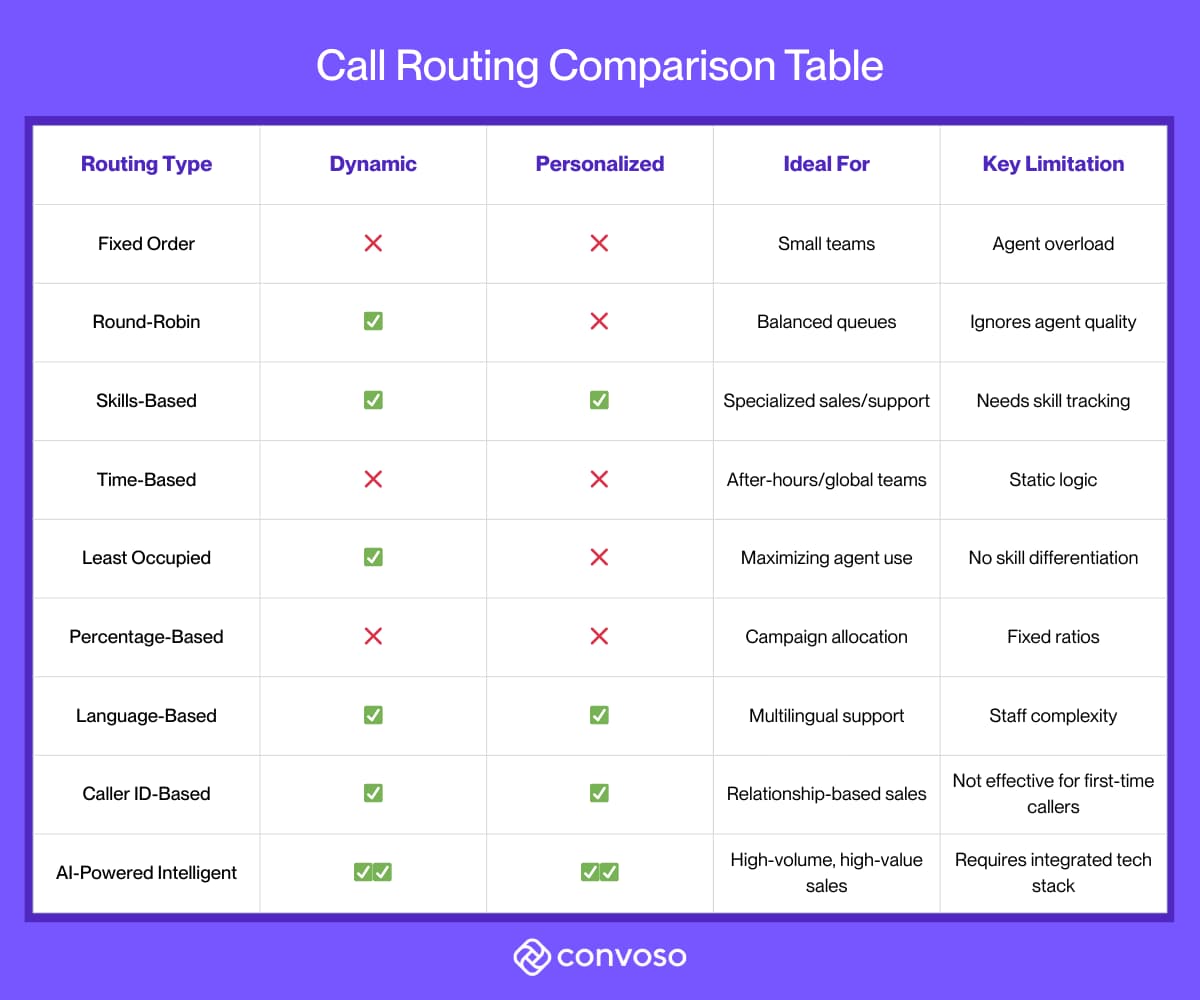
9 types of call routing (with pros, cons & use cases)
Here’s an in-depth look at the most common call routing strategies used in sales and support environments:
1. Fixed order routing
Fixed order routing distributes calls to agents in a specific, static order. The system always tries the first agent in the list, and if they're unavailable, it moves to the next, and so on.
Pros:
Easy to set up and manage
Prioritizes senior or top-performing agents (if intentionally structured that way)
Cons:
Can create a workload imbalance
Often leads to burnout or underutilization
Doesn’t scale well for larger teams or high-volume call centers
Real-World Use Case: In a small sales team of 3–4 agents, a manager might prioritize their most experienced closer as the first recipient of every high-value lead. However, if that agent is frequently busy, the rest of the team may be left waiting or underutilized.
Best For: Very small teams or teams with one or two designated lead handlers.
2. Round-robin routing
Round-robin routing sends each new call to the next agent in a looping order, ensuring that call volume is distributed evenly.
Pros:
Balances call distribution
Prevents favoritism or uneven workloads
Simple to implement for moderate-sized teams
Cons:
Ignores agent specialization or performance
Doesn’t adapt to changes in lead quality or campaign goals
Real-World Use Case: For an outbound sales campaign generating a consistent volume of leads, round-robin ensures every rep gets an equal shot. However, a lower-performing agent may receive the same high-quality leads as a top seller, leading to missed opportunities.
Best For: Training environments or generalist teams with equal capabilities.
3. Skills-based routing
Skills-based routing evaluates the agent's specific abilities and experience to match the right person to each call—especially critical in environments with complex products or highly segmented customer bases.
Pros:
Increases first-call resolution and conversions
Reduces transfers and escalations
Empowers agents to specialize and excel
Cons:
Requires active skill tagging and frequent audits
Mislabeling agents can negatively impact performance
Real-World Use Case: A lead interested in refinancing a home loan is routed to agents certified in mortgage products, while first-time buyers are routed to a team specializing in new homebuyer programs.
Best For: Sales organizations with multiple product lines, industries, or regulatory categories.
4. Time-based routing
Time-based routing uses the time of day, week, or holiday calendar to determine which queue or team receives the call. It’s frequently used to support multi-shift operations or global customers.
Pros:
Ensures 24/7 coverage
Supports offshoring or nearshoring strategies
Automates business hour logic
Cons:
Doesn’t consider agent performance or lead quality
Static logic lacks flexibility in real-time
Real-World Use Case: A BPO serving clients in both the U.S. and Australia might route East Coast leads to U.S. agents from 9–5 ET, and reroute those same queues to Sydney after-hours.
Best For: Call centers with global coverage or strict scheduling needs.
5. Least cccupied routing
This approach routes calls to the agent who has had the least talk time or idle activity recently. It’s designed to optimize agent utilization and ensure no one is sitting idle while others are overwhelmed.
Pros:
Maximizes team utilization
Encourages even workload distribution
Keeps agents engaged and productive
Cons:
Ignores agent expertise or historical performance
Can send high-value leads to low performers
Real-World Use Case: In a high-volume outbound campaign, this logic ensures every rep stays busy—but without performance filters, it may unintentionally lower your conversion rate by over-prioritizing availability over skill.
Best For: Operations focused on maximizing agent hours over lead quality.
6. Percentage-based routing
This method splits traffic by percentages—for example, sending 70% of leads to Team A and 30% to Team B. It’s useful for prioritizing campaigns, balancing multiple clients, or testing new initiatives.
Pros:
Enables controlled testing
Helps prioritize high-value campaigns
Easy to adjust across different teams or clients
Cons:
Rigid: not responsive to real-time data
Misconfigurations can lead to channel imbalance
Real-World Use Case: A company testing a new sales script might route 20% of incoming leads to a pilot team, while the other 80% follows standard workflows. It’s an ideal setup for A/B testing performance.
Best For: Multi-client call centers, SLA compliance, or campaign testing.
7. Language-based routing
Language-based routing directs callers to agents fluent in a particular language, based on IVR input, caller location, or stored customer data.
Pros:
Improves customer comfort and trust
Enhances communication accuracy
Reduces call handling time for non-English speakers
Cons:
Requires accurate language detection
Limited multilingual staffing may lead to longer queues
Real-World Use Case: In a call center serving both English and Spanish-speaking populations, language-based routing ensures Spanish-speaking leads are connected directly with bilingual agents.
Best For: Multilingual or international sales/support organizations.
8. Caller ID-based routing
This method uses a caller’s phone number to trigger a routing decision. Known customers may be routed to their previous agent or a dedicated team, supporting continuity and account familiarity.
Pros:
Enables white-glove service and relationship-based sales
Reduces repetition and speeds up resolution
Ideal for VIP accounts or recurring sales cycles
Cons:
Doesn’t serve new leads effectively
Relies on accurate number-to-contact matching
Real-World Use Case: A returning Medicare customer is routed to the same licensed rep they spoke with during open enrollment last year—supporting retention and faster closing.
Best For: Relationship-based sales teams or account management roles.
9. Intelligent AI-powered routing
AI-powered routing analyzes multiple real-time and historical data points—such as performance metrics, intent, CRM stage, and behavioral signals—to make predictive routing decisions.
Pros:
Maximizes high-intent lead conversion
Dynamically adjusts to team performance
Great for scaling personalization at volume
Cons:
Requires an integrated tech stack and clean data
Setup and tuning take time
Real-World Use Case: Convoso’s AI engine might route a hot Medicare lead (from a priority ZIP code, requesting a call during peak season) to a top-performing agent with the best close rate on similar profiles.
Best For: High-volume outbound sales and revenue teams seeking performance-based optimization.
6 best practices for call routing optimization
With AI tools, hybrid teams, and increasing performance pressure, call centers in 2025 must evolve their routing strategies. Here’s how to stay ahead:
1. Align routing with revenue goals
Define routing rules based on what drives conversions—skills, response speed, or personalization. Don’t treat every call equally.
2. Use real-time performance data
Incorporate metrics like conversion rate or average handle time to dynamically route leads to top-performing agents.
3. Integrate with CRM and campaign tools
Routing should reflect the buyer stage, campaign type, and past interactions. Use CRM data to personalize experiences.
4. A/B test your routing strategies
Test percentage-based vs. AI routing, or different skill rules, to find what performs best across campaigns.
5. Prioritize Speed-to-Lead
Especially for outbound or lead response calls, ensure your best agents are prioritized for high-intent leads based on immediacy.
6. Use AI intelligently, not blindly
Ensure AI logic aligns with business rules. Regularly audit the performance of AI-based routing paths and make adjustments.
How Convoso powers smarter call routing
Convoso’s routing engine is purpose-built for outbound sales and lead generation. Our customers see higher conversion rates and better ROI because our tools go beyond basic call distribution:
AI-Powered Routing Engine: Leverages machine learning to assign leads based on intent, agent performance, and conversion likelihood.
CRM-Integrated Routing: Syncs with your lead and campaign data for personalized interactions.
Real-Time Agent Tracking: Adjusts routing logic dynamically based on agent performance.
Omnichannel Routing: Supports consistent experiences across phone, SMS, and email channels.
👉 See how Convoso’s smart routing works ›
Turn smarter routing into greater revenue
Smarter routing isn’t just about faster connections—it’s about more profitable ones. By matching the right lead to the right agent with the right timing, you unlock more conversions, higher productivity, and greater revenue.
Whether you’re managing inbound support or high-volume outbound sales, the routing strategies you choose will directly impact outcomes. If you’re ready to upgrade from basic ACD logic to intelligent, conversion-focused routing, Convoso can help.
Ready to accelerate revenue with smarter call routing?
Schedule a demo
Supercharge your sales with our AI-powered contact center platform.