

The Rise of Consumer Call Screening: How Outbound Teams Can Protect Contact Rates
 Convoso
TL;DR
Consumer call screening is accelerating across carriers, third-party apps, and handset ecosystems — and it’s materially impacting outbound contact rates.
Over 65% of U.S. mobile users rely on screening tools
iOS 26 shifts call control to the handset
Outbound teams need to combine proactive screening response with real-time dialing optimization
The rise of consumer call screening
Call screening is no longer a niche feature — it’s becoming default behavior.
Carriers have steadily expanded spam labeling and blocking tools. Third-party apps use massive datasets and AI models to detect suspicious calling patterns. Device operating systems are now embedding screening logic directly into the handset.
At the same time, TransUnion reports tightening right-party contact rates as consumers grow increasingly selective about answering unknown calls .
The default response to an unfamiliar number is no longer curiosity — it’s caution.
For outbound-centric organizations, this represents a structural shift in the voice channel.
Why contact rates are under pressure
Outbound performance was once primarily influenced by carrier-level filtering and dialing behavior. Today, screening occurs across multiple layers:
Carrier spam detection
Third-party screening apps
Device-level interception
Consumer reporting loops
This multi-layered ecosystem creates friction before a live conversation ever begins.
Numbers that are technically “clean” can still underperform. Campaigns that previously converted reliably may experience unexplained declines. Traditional reputation dashboards cannot fully explain the drop, because screening decisions increasingly occur beyond carrier-level visibility.
The result is measurable margin pressure — fewer connects, more dials per conversion, rising CPA.
Why iOS 26 represents a tipping point
While screening has been rising for years, iOS 26 represents an acceleration point.
With Smart Call Screening, Apple shifted part of outbound call control from carriers and dialers to the handset itself. Unknown callers may be required to identify themselves and state their purpose before the device rings or routes the call.
This matters because of scale, since iOS accounts for roughly 60% of U.S. mobile OS market share.
As adoption spreads, the screening experience reaches a majority of outbound targets.
The impact is visible. As of January 2026, Convoso was seeing approximately 10% of outbound calls routed to screening environments.
While iOS 26 did not create call screening, it significantly expanded its operational impact.
Android ecosystems are expected to continue tightening similar standards. This is not a platform-specific issue; it is an ecosystem evolution.
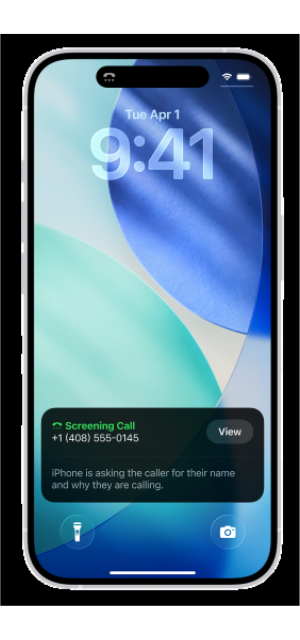
Apple’s iOS call screening feature asks unknown callers to identify themselves before the phone rings.
From avoiding spam flags to proving legitimacy
In this environment, outbound strategy must evolve.
The old objective was simple: avoid being flagged.
The new objective is more nuanced: prove legitimacy immediately.
When a handset prompts, “Who is calling and why?”, that identification becomes part of the user’s decision-making process. Transparency and clarity now influence answer rates directly.
Compliance is no longer just regulatory protection — it is performance protection.
How Convoso addresses the call screening shift
Rather than reacting after performance declines, Convoso shipped a platform-level Call Screening capability designed to preserve contact rates as handset standards evolve .
When a call is intercepted:
An automated identification message can clearly state who is calling and the purpose of the call .
Screening events are detected and logged.
Agents are notified.
Screen-aware routing logic helps maintain contact rate and AMD accuracy .
This capability deploys without downtime or additional fees .
Call Screening helps preserve performance once the handset intervenes.
See how outbound teams are adapting to call screening
Call screening isn’t just a technical change — it’s reshaping how outbound teams reach prospects. See how Convoso helps sales organizations maintain contact rates as handset-level screening expands.
Learn how Convoso Ignite helps protect outbound contact rates
Convoso Ignite: Optimizing contact rates before the call is placed
If Call Screening protects performance during interception, Convoso Ignite improves performance upstream.
Ignite is the intelligence behind best-in-class outbound performance. It transforms number management from administrative burden into strategic advantage.
Continuous Health Scoring
Each number is continuously evaluated across a dynamic performance spectrum — factoring in contact rate, answer rate, and usage trends — so teams understand how numbers are contributing to results.
Automated Procurement and Intelligent Assignment
Ignite automates the procurement and assignment of new numbers based on campaign needs, reducing manual overhead and maintaining a healthy dialing pool.
Real-Time Dialing Optimization
Using AI-driven real-time dialing optimization, Ignite prioritizes the highest-performing numbers for each lead as calls are placed — intelligently leveraging performance data instead of relying on static rotation.
Teams using Ignite have reported:
Up to 50% increases in contact rates
Fewer dials per connect
Lower cost per acquisition
Improved agent productivity
In a screening-heavy ecosystem, proactive number intelligence becomes foundational.
The 2026 playbook: protecting contact rates in a screening-first world
Screening is not a temporary trend. It is embedded infrastructure.
To protect performance, outbound leaders should:
Treat device-level screening as structural, not temporary
Ensure every call clearly identifies the caller and purpose
Monitor number health continuously rather than relying on binary reputation
Deploy real-time dialing optimization to prioritize strongest-performing numbers
Choose platforms that respond proactively to carrier and handset evolution
Those who combine screening adaptation with AI-driven dialing intelligence will maintain stability and profitability in 2026 and beyond.
Don’t get screened out in 2026 — get smarter
Consumer call screening is no longer emerging — it is accelerating.
Carriers, third-party apps, and handset ecosystems are reshaping how voice connections are made. The handset now participates in the outbound interaction.
Outbound teams that treat this as incremental friction will struggle. Teams that treat it as structural change — and deploy proactive screening response alongside intelligent dialing optimization — will protect contact rates, reduce wasted spend, and unlock more profitable performance in 2026 and beyond.
See how Convoso helps outbound teams stay connected as call screening expands.
Learn how Convoso’s Call Screening capability and Convoso Ignite work together to protect contact rates and optimize dialing performance in today’s screening-first environment.
FAQs: Consumer call screening and outbound performance
Yes. Over 65% of U.S. mobile users rely on screening tools, with continued growth projected.
Approximately 10% of calls on the Convoso platform are already reaching screening environments.
Because screening now occurs across carrier, app, and handset layers — not just traditional spam flags.
No. It is included as a platform capability.
Call Screening preserves contact rates during device interception. Ignite continuously evaluates number performance and uses real-time dialing optimization to prioritize the highest-performing numbers before the call is placed.
Schedule a demo
Supercharge your sales with our AI-powered contact center platform.