

Beyond Speed to Lead: From First Attempt to Meaningful Engagement
 Convoso
TL;DR
Making the first call within seconds doesn't tell you whether a prospect answered, completed qualification, or reached the right salesperson. Speed to lead captures the start of outreach, but not what happens next.
Voice AI can handle parts of the conversation after contact is made, including gathering information and asking qualification questions. That gives teams another way to reduce delays between the first connection and the next step.
The aim is to remove unnecessary waiting—not rush the conversation or send every prospect straight to a seller.
Every outbound leader wants agents spending more time talking to prospects. That makes Agent Talk Time an obvious metric to watch—and, for many teams, one worth actively improving.
A new lead enters a campaign, and the first call goes out within seconds. The team has hit its response-time target.
But what happened next?
Did the prospect answer? Did the conversation establish interest and fit? Did a qualified prospect reach someone who could help them take the next step?
Our guide to speed to lead explains how to measure and improve the time between an inquiry and the first outreach attempt. For teams adding AI to their outreach, the next opportunity is to examine the gaps that remain after that attempt.
A fast first attempt doesn’t always mean fast engagement
Consider two leads that both receive an initial call within seconds.
One answers, completes qualification, and reaches the appropriate salesperson. The other doesn’t answer until a later attempt—or connects but needs a callback before qualification can continue.
Their speed-to-lead numbers may look nearly identical. Their experiences are different.
The first-attempt metric can’t explain that difference on its own. It tells you how quickly outreach started, not how long it took to establish a conversation or what that conversation accomplished.
That distinction gives revenue teams a more specific question to investigate:
Where does the process slow down after the first call goes out?
Find the gaps between contact, qualification, and handoff
The path from a new lead to a sales conversation might look like this:
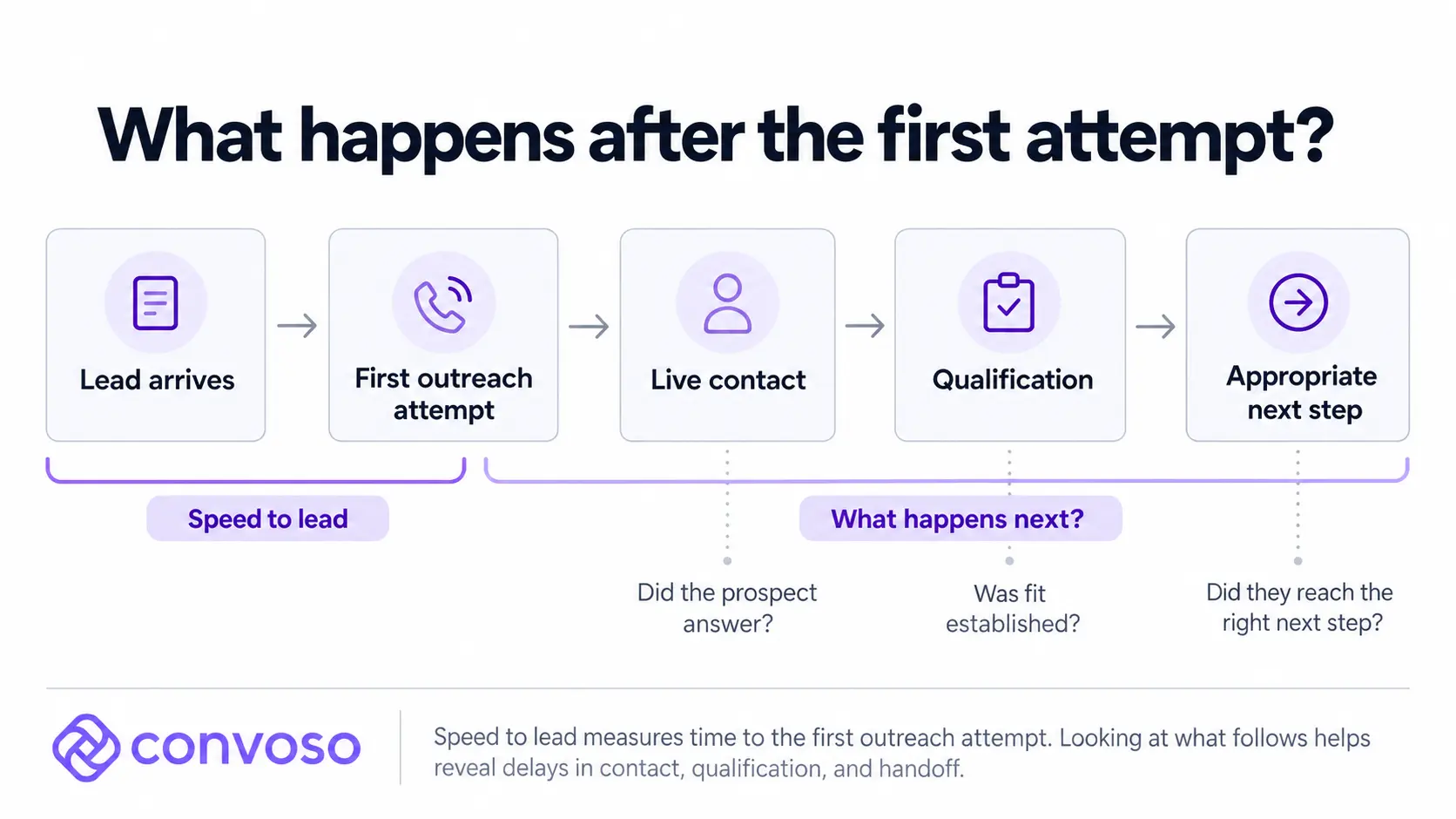
Each transition can reveal a different issue.
A lead that takes several attempts to reach presents a different challenge from a connected prospect waiting for someone to complete qualification. And a qualified prospect waiting for an available salesperson points to a different constraint again.
Looking at those stages separately helps teams identify what actually needs attention. Faster dialing won’t resolve every delay, just as adding more people won’t fix every routing or workflow problem.
The useful distinction is between time spent advancing the conversation and time spent waiting for the process to catch up.
Voice AI can help after the call connects
Dialing, lead prioritization, and campaign automation help get fresh leads into outreach quickly. Voice AI can address a different part of the process: the opening conversation.
Depending on the use case, an AI agent can engage the prospect, collect information, ask defined qualification questions, and determine the appropriate next step.
When those steps would otherwise depend on an available human agent, Voice AI can help keep the interaction moving.
That doesn’t necessarily make the first attempt faster. The outbound platform may already handle that well. Instead, it can reduce the reliance on human availability for selected steps after contact is made.
The next stage still needs to be ready. If AI completes qualification but the prospect then waits for a salesperson or a manual routing decision, the delay has moved rather than disappeared.
Faster engagement still needs a clear next step
A short conversation isn’t automatically a successful one. As we explored in our article on Agent Talk Time and outbound performance, time spent talking needs to be considered alongside what the conversation actually accomplished.
For a qualification workflow, the AI needs to gather the information required to assess fit and determine whether the prospect should advance. Moving someone along before those questions are resolved can leave the salesperson repeating the work.
In How AI-Supported Outreach Creates More Time to Sell, we discussed how effective qualification and a well-managed handoff help sellers continue the conversation rather than restart it.
That means giving prospects time to answer and ask questions, while removing avoidable waits around the interaction. The goal is a smoother path to the appropriate next step—not the shortest possible call.
Measure where prospects wait and where they move forward
Keep tracking speed to lead. Then look at the stages that can explain what happens beyond that first attempt:
Time to live contact: How long does it take to reach the prospect?
Time to qualification: Once connected, how long does it take to establish whether the prospect should advance?
Time to the next step: After qualification, how long does the prospect wait for a transfer, appointment, or other appropriate action?
Results: Are those interactions producing qualified transfers and sales, or simply more activity?
These measures are most useful when considered together. A shorter qualification process, for example, is not necessarily an improvement if more unsuitable leads reach sellers. Likewise, quick AI engagement may hide a growing wait for human assistance.
Use these measures to identify where prospects get stuck—and whether changes improve outcomes rather than simply shorten one step in the process.
Keep the process moving after the first attempt
For a team already reaching fresh leads quickly, the next improvement may lie between the first connection and the sales conversation.
That is part of the model behind Convoso Voice AI Agent: engage and qualify leads at scale, then transfer qualified prospects to human agents who can take the conversation further.
A fast first attempt is a strong start. What follows determines whether that speed becomes a better sales opportunity.
Move beyond the first attempt
Discover how Convoso Voice AI Agent brings AI-powered lead qualification and human handoff into the outbound workflow.
FAQ: From speed to lead to sales engagement
Speed to lead measures the time between a prospect expressing interest and the business making its first outreach attempt. It shows how quickly the team responds, but not whether that attempt results in a conversation.
No. A first attempt may go unanswered. Time to contact measures how long it takes to reach the prospect, which may require several attempts.
A fast first attempt can hide delays later in the process. Tracking contact, qualification, and the next step helps teams see where prospects wait and whether faster outreach leads to better results.
Depending on the workflow, a voice AI agent can engage the prospect, gather information, ask qualification questions, and determine the appropriate next step. This can reduce the need for a person to handle every part of the opening interaction.
No. Dialing and voice AI address different parts of the process. Dialing helps initiate contact, while voice AI can handle selected parts of the conversation once the prospect answers.
Useful measures include time to live contact, time to qualification, the wait for a transfer or other next step, qualification rates, and sales outcomes. Together, these help show whether the process is improving—not simply starting faster.
Schedule a demo
Supercharge your sales with our AI-powered contact center platform.