

Agent Talk Time: The Most Misunderstood KPI in Outbound
 Convoso
TL;DR
Agent Talk Time is an important outbound KPI, but it shouldn’t be evaluated in isolation. The real goal is to turn agent hours into more successful outcomes. Dialing, number health, AMD, speed-to-lead, lead quality, campaign pacing, and agent availability all influence how much productive conversation time agents get. Measure Talk Time alongside outcome KPIs and the operational signals that help explain what’s actually driving—or limiting—performance.
Every outbound leader wants agents spending more time talking to prospects. That makes Agent Talk Time an obvious metric to watch—and, for many teams, one worth actively improving.
But Talk Time only becomes meaningful when you understand what the operation is trying to accomplish. Ultimately, outbound operations exist to produce successful outcomes: sales, conversions, transfers, appointments, or whatever result the campaign is designed to generate.
That's why one of the most useful ways to evaluate outbound productivity is successful outcomes per agent hour worked. It connects the result the business cares about with the time required to produce it.
Agent Talk Time is an important supporting KPI: the more productive time agents spend talking to the right people, the more opportunities they have to generate results.
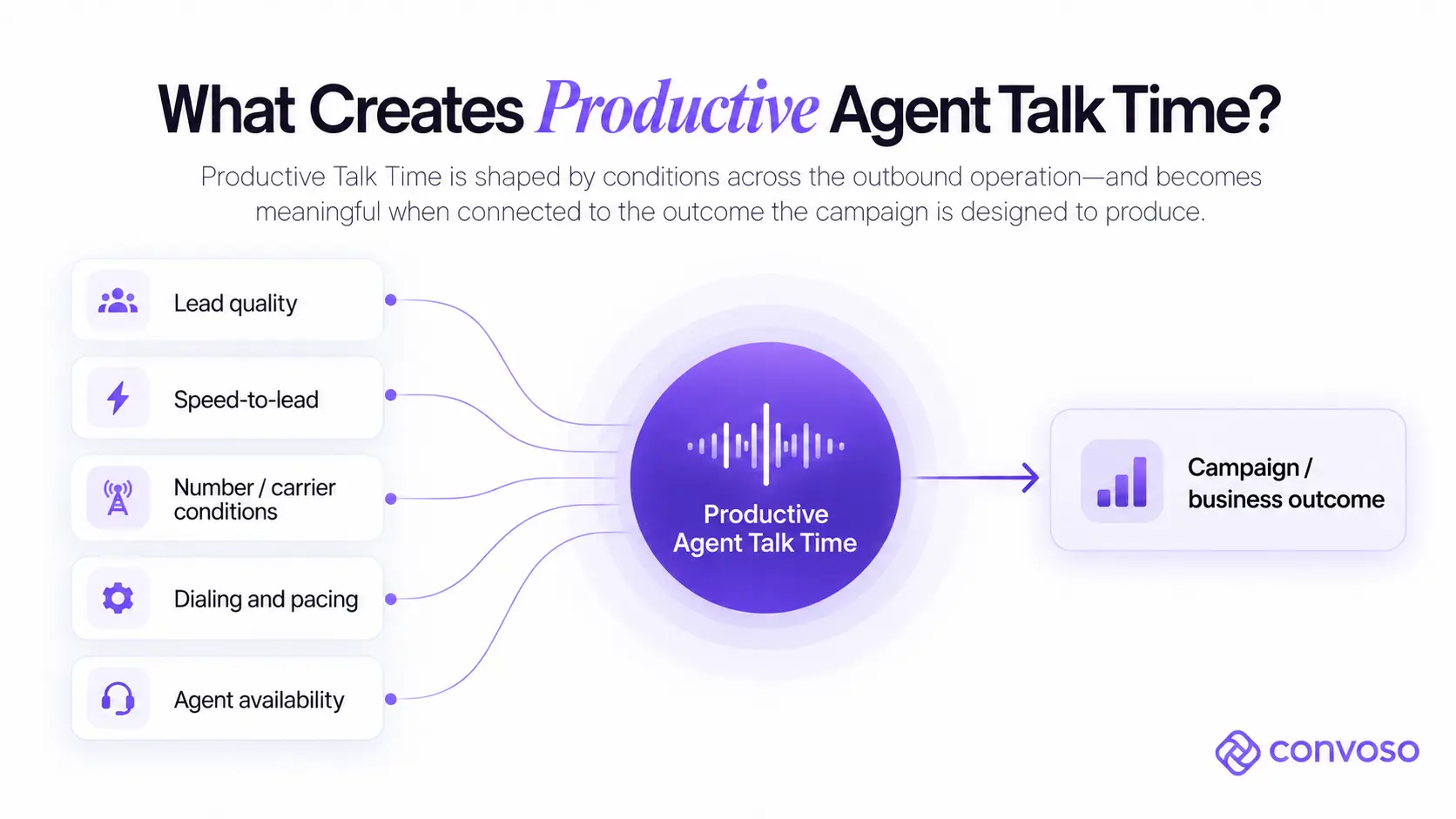
But here's the part many outbound teams underestimate: how much productive Talk Time agents get is heavily influenced by the technology and operating strategy behind the call. Many of the conditions that determine whether a productive conversation happens are set before anyone ever says “hello”: dialing and pacing, number health and carrier conditions, lead quality, speed-to-lead, answering machine detection, campaign automation, and agent availability.
That’s why treating Agent Talk Time primarily as a measure of individual agent performance can obscure what’s actually limiting performance.
Don’t ask the wrong questions
When Agent Talk Time falls, managers often look first at the agent.
Are agents spending too much time idle? Do they need additional coaching? Are they following the script? Are they handling objections effectively?
Those can be reasonable questions once a conversation happens. But they don't account for everything required to create the conversation in the first place.
Agents can't control whether a carrier filters a call. They can't prevent a number from degrading throughout the day. They can't make an aging lead more likely to answer. And they don't determine whether the dialing platform connects them to a live prospect or another voicemail.
So before asking what's wrong with the agent, ask two broader questions:
What outcome are we trying to produce, and what role does Agent Talk Time play in producing it?
Then:
What is happening across the operation that is creating—or limiting—productive conversation time?
That changes what you investigate.
You can optimize Talk Time. You can’t optimize it in isolation.
Agent Talk Time is affected by multiple operational factors working together.
Answering machine detection (AMD) is one example. A system that leaks voicemails to agents wastes time that could have been spent with a person. A system that misclassifies a human as a voicemail loses a potential conversation entirely. And if it takes too long to connect an answered call to an available agent, the prospect may hang up before the conversation starts.
The same principle extends beyond AMD. Carrier routing, number management, dialing strategy, call classification, agent routing, and even the time required to disposition and wrap up a call can affect how much productive conversation time an agent can generate during a shift.
The conditions behind productive Talk Time
Improving Talk Time requires understanding the conditions that create it.
A decline in Talk Time might be related to changes in number health or carrier filtering. Slow speed-to-lead can reduce the likelihood of reaching an interested prospect. Answering machine detection can affect how much agent time is spent on live conversations. Lead quality, campaign pacing, agent availability, and workflow decisions can all change the opportunities agents have to talk to the right people.
By the time an agent receives a call, many of the variables determining that conversation have already been decided.
That doesn't make Talk Time less important to optimize. It changes how you optimize it.
Our conversations with outbound operators suggest teams actively work to increase productive Talk Time because more time in meaningful conversations creates more opportunities to generate the outcomes they care about.
Asking an agent to talk more doesn't fix slow speed-to-lead, poor connection rates, unhealthy numbers, inaccurate answering machine detection, or dialing that isn't keeping agents consistently connected to live prospects.
Productivity is always a balancing act
Those conditions also change throughout the day.
Call too aggressively and you risk exceeding allowable abandonment-rate thresholds. Call too conservatively and agents spend more time waiting than talking. Lead quality changes. Carrier behavior changes. Agents become available or unavailable. Answer patterns shift.
High-performing outbound operations have to continually rebalance around those conditions while maintaining productivity and compliance.
That rebalancing isn't a one-time calibration at the beginning of a shift. Each time conditions change—fewer leads answer than expected, an agent steps away, or a carrier tightens its filters—the operation has to adjust again.
Dialing platforms that overcorrect when they approach the abandonment ceiling can lose momentum quickly. Rebuilding that momentum takes time—and that lost time shows up as idle agents.
The operations that hold Talk Time steady aren't necessarily the ones that ramp up fastest. They're the ones that lose the least momentum as conditions change.
More Talk Time isn’t the goal either
More Talk Time doesn't automatically mean better performance.
A fifteen-minute conversation with someone who has no buying intent isn't necessarily more valuable than a four-minute conversation that results in a qualified transfer.
The goal isn't longer conversations. It's more productive conversations.
What the data shows
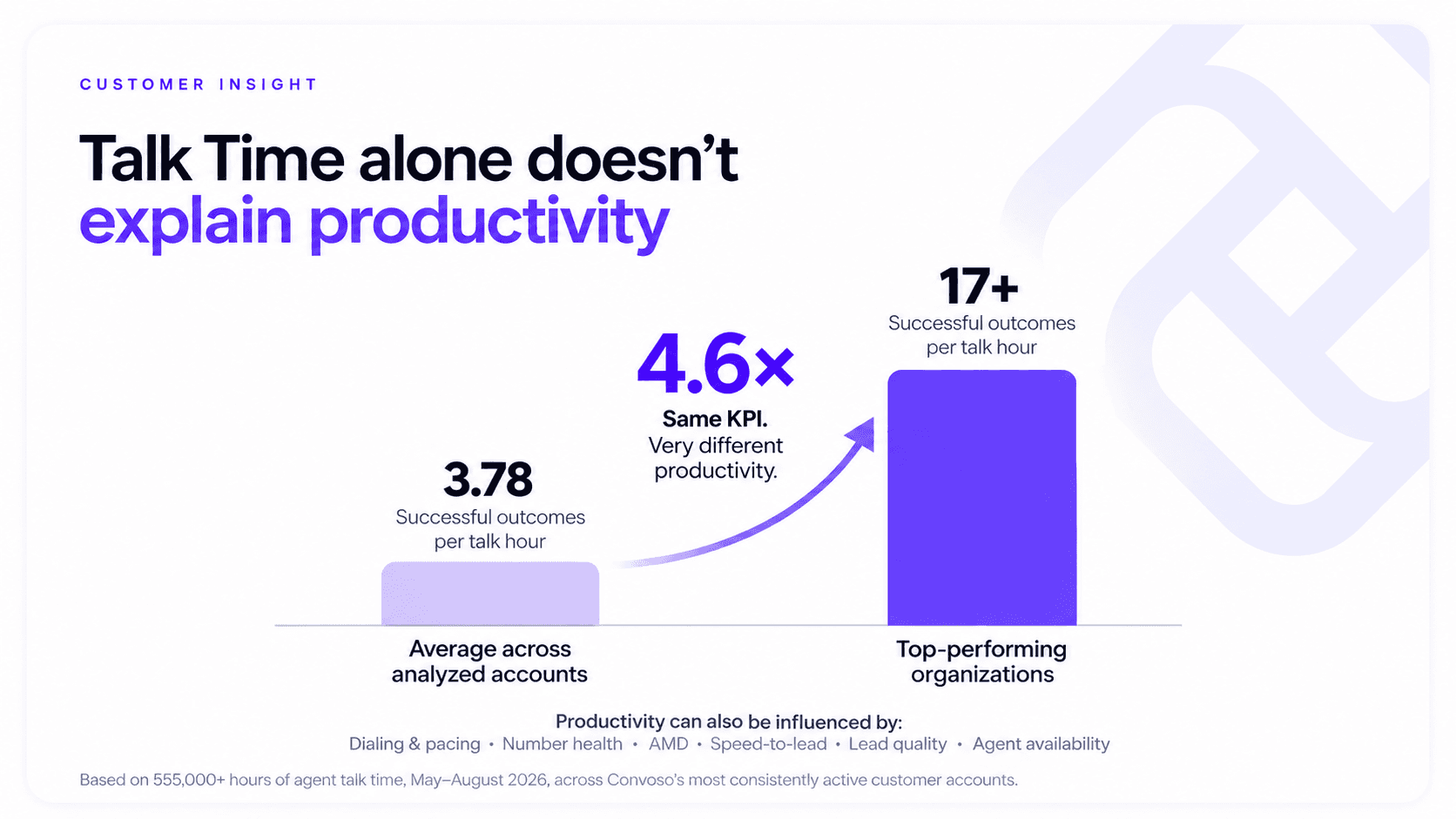
Based on more than 555,000 hours of agent talk time from May through August 2026 across Convoso's most consistently active customer accounts, agents averaged 3.78 successful outcomes per talk hour. Top-performing organizations achieved more than 17 successful outcomes per talk hour—a roughly 4.6x gap that shows why Talk Time alone doesn't explain productivity.
Productivity looks different across operations
Our customer conversations reinforced that distinction. For example:
Call Gurus
They measure productivity based on successful outcomes per billable hour. But the definition of a successful outcome changes by client and campaign. For one campaign it might be a successful transfer; for another, an appointment.
Agent Talk Time is one of the metrics they actively optimize because increasing productive conversation time can create more opportunities to generate those successes.
Medigap
This insurance team looks at the operation differently. Contact rate and successful transfers per hour are important measures, alongside agent-level metrics such as call time, billable percentage, and calls per hour. Even relatively small changes in contact rate can materially affect daily performance.
But the team doesn't rely on those aggregate measures alone. They also audit call recordings across different levels of agent performance to understand the quality of the conversations underneath the numbers. An agent can appear productive on the surface while closer examination tells a different story.
The specific outcome varies by business and campaign—a sale for one organization might be a qualified transfer or appointment for another. But across our customer conversations, the common denominator was productivity: how many successful outcomes the operation produces for the agent time invested.
That gives Agent Talk Time important context. Talk Time isn't the end result. It's one of the operational KPIs that helps explain whether agents are getting enough productive opportunities to generate the outcomes the business ultimately cares about.
Triangulate, don’t isolate
Once you've defined the outcome and the KPI you’ll use to track success, the next question is what is driving performance.
That's where operational KPIs become valuable. Agent Talk Time is one of them, but it becomes more useful when viewed alongside the other signals that shape or explain outbound performance.
Contact rate can tell you how often someone answers.
Transfer rate can show whether conversations are producing a desired next step.
Agent idle time can reveal whether available capacity is going unused.
Call classification can help establish what actually happened on calls.
Number health can help determine whether outbound numbers are supporting or limiting the ability to connect.
Agent talk time can tell you how much time agents are actually spending in conversation.
None tells the full story by itself.
Why one KPI can’t explain performance
A healthy contact rate doesn't necessarily mean the operation is producing the right outcomes. Higher Talk Time doesn't automatically mean conversations are productive. A strong calls-per-hour number can mask differences in conversation quality.
This is a basic limitation of any aggregate KPI: it can tell you that performance changed without necessarily telling you what produced the change.
That is why teams need to triangulate across multiple operational signals. Your primary KPI tells you whether you're producing the result you need. The surrounding signals help you investigate what changed, where performance may be breaking down, and where to act.
Agent Talk Time is one useful entry point for understanding what is happening across the outbound operation and where to investigate next. Can you classify call outcomes precisely enough to understand what actually happened? Do you have enough operational visibility to explain why performance changed? And can you connect those signals across the broader outbound system?
The bigger picture
Ultimately, outbound productivity comes down to how effectively an operation turns agent time into successful outcomes.
Agent Talk Time is an important part of that equation because agents can't generate sales, transfers, or appointments if they aren't spending enough productive time talking to the right people.
What many outbound teams underestimate is how much of that conversation time is determined behind the scenes. Dialing, pacing, AMD, speed-to-lead, number health, routing, and workflow efficiency all influence how many productive conversations an operation can create with the agent hours it has available.
Individually, each may look like a technical or operational detail. Together, they shape outbound productivity.
That's why Agent Talk Time matters. It sits between the technology running the outbound operation and the outcomes the business ultimately cares about.
The goal isn't Talk Time for its own sake. It's creating more productive conversation opportunities so every agent hour has a better chance of producing a sale, conversion, transfer, appointment, or other successful outcome.
Turn more agent time into productive conversations
Convoso helps high-velocity outbound teams improve the conditions behind every conversation—from dialing and call classification to intelligent number management, campaign automation, and real-time performance visibility.
Frequently asked questions about Agent Talk Time
Agent Talk Time is the amount of time an agent spends actively speaking with prospects or customers during calls. In outbound operations, it can help show how much of an agent's available time is being spent in actual conversations rather than waiting, handling voicemails, or completing other tasks.
No. Higher Talk Time does not necessarily mean higher productivity. A longer conversation that produces no meaningful result may be less valuable than a shorter conversation that leads to a sale, qualified transfer, appointment, or other successful outcome. The goal is productive conversation time, not simply longer calls.
Agent Talk Time can be influenced by dialing and pacing, lead quality, speed-to-lead, answering machine detection, number health, carrier filtering, campaign workflows, call routing, and agent availability. Many of these factors are determined before an agent begins speaking with a prospect.
Useful complementary KPIs can include contact rate, transfer rate, agent idle time, call classification, number health, conversions per hour, successful outcomes per agent or billable hour, and revenue per hour. The right combination depends on the campaign's objective.
Start with the business outcome the campaign is designed to produce—such as sales, conversions, transfers, or appointments—and evaluate how many of those successful outcomes are generated for the agent time invested. Agent Talk Time and other operational KPIs can then help explain what is contributing to or limiting that performance.
Schedule a demo
Supercharge your sales with our AI-powered contact center platform.