

Your Voice AI Agent Can “Talk.” But Can It Hold a Conversation?
 Convoso
TL;DR
A natural-sounding voice isn't enough to make an effective voice AI agent. The real test is whether it can respond quickly, handle interruptions, recognize language changes, and adapt to unexpected questions while working toward a defined objective.
Businesses evaluating voice AI should look beyond polished demonstrations and test how the technology performs in realistic customer conversations.
A voice AI agent can sound warm, natural, and convincingly human.
But what happens when a customer interrupts? Changes the subject? Asks an unexpected question? Or starts speaking Spanish?
These are the moments that reveal whether an AI agent can do more than produce convincing speech.
For outbound sales and customer engagement teams, the distinction matters. The agent isn't there simply to deliver a polished script. It needs to understand what someone is saying, respond appropriately, and help move the interaction toward a useful outcome.
An AI agent doesn't need to convince someone it's human. It needs to conduct an effective conversation.
Why natural-sounding speech isn't enough
Advances in speech synthesis have made AI-generated voices increasingly realistic. Convoso Voice AI Agent offers more than 700 voices, with options to customize emotional tone, speaking speed, and other characteristics to suit a business and its audience.
But even a convincing voice tells us relatively little about how an agent handles an actual customer interaction.
Consider a prospect who answers a qualification question with, "Well, that depends. Are you asking about my current coverage or what I'm looking for next year?"
A rigid conversational system might repeat the original question or continue down the wrong path. A more capable agent should recognize that the prospect needs clarification before proceeding.
That distinction separates generating speech from understanding a conversation.
The following capabilities are particularly important when evaluating voice AI for customer engagement.
How does response speed affect voice AI conversations?
Think about an ordinary phone conversation. People respond quickly, sometimes acknowledging what they've heard before the other person finishes speaking.
With voice AI, delays between a customer's response and the agent's next statement can make an interaction feel mechanical or leave callers wondering whether they've been understood.
That's why response latency matters.
Convoso Voice AI Agent delivers sub-second responses designed to reduce awkward pauses and support more fluid interactions.
But speed alone isn't enough. A fast response that misses the customer's point may be just as frustrating as a delayed one.
Effective voice AI needs both responsiveness and an appropriate response.
Can the AI handle interruptions and unexpected questions?
Real conversations rarely follow a perfectly ordered exchange.
Customers interrupt, correct themselves, ask follow-up questions, and sometimes change direction entirely.
An AI agent needs to recognize when someone wants to redirect the conversation. It should also distinguish meaningful interruptions from brief acknowledgements such as "right," "okay," or "uh-huh."
For example, imagine an AI agent asking about a prospect's interest in a particular service. Halfway through the explanation, the prospect says, "Actually, I already have that. I'm looking for something different."
The agent should respond to the new information rather than continue asking questions that no longer apply.
This requires interruption handling and the ability to maintain conversational context.
Can voice AI recognize language changes during a call?
Multilingual capabilities are another important measure of conversational performance. Convoso Voice AI Agent supports more than 32 languages, but it's one thing to support multiple languages and another to recognize when someone switches languages mid-conversation.
At Ace Building Materials, a family-owned supplier, president Josh Zakarya has experienced this capability firsthand.
The company uses Convoso Voice AI Agent to answer incoming calls, respond to common questions, and direct customers to the appropriate department. Josh was particularly impressed by how the agent recognizes when a caller switches from English to Spanish and immediately responds in Spanish.
"This Convoso agent speaks fluent Spanish. It's an amazing agent. That's a great feature," Josh says.
Although Ace primarily uses its voice AI agent for inbound call handling, the same capability can benefit outbound engagement, where a prospect's preferred language may not be known before the call connects.

Can the AI accomplish the purpose of the conversation?
Natural speech, responsive interactions, interruption handling, and language recognition all contribute to conversational quality. But an effective AI agent also needs to accomplish the purpose of the call.
For outbound lead qualification, that may mean establishing interest, gathering information, answering preliminary questions, and determining whether a prospect is ready to speak with a salesperson.
Doing that well requires understanding responses, asking relevant follow-up questions, and recognizing when to move to the next step. This ability to work toward a defined objective is central to agentic AI for revenue teams.
For example, once an agent determines that a prospect meets the qualification criteria and wants to continue the discussion, transferring the conversation to a salesperson may be more useful than asking additional questions.
The goal isn't to keep the AI talking as long as possible. It's to complete the assigned task and help the customer reach the appropriate next step.
How to evaluate voice AI conversation quality
A polished demonstration can showcase the quality of an AI-generated voice. But businesses should also test how an agent responds to the situations their customers actually encounter.
Here are five practical tests:
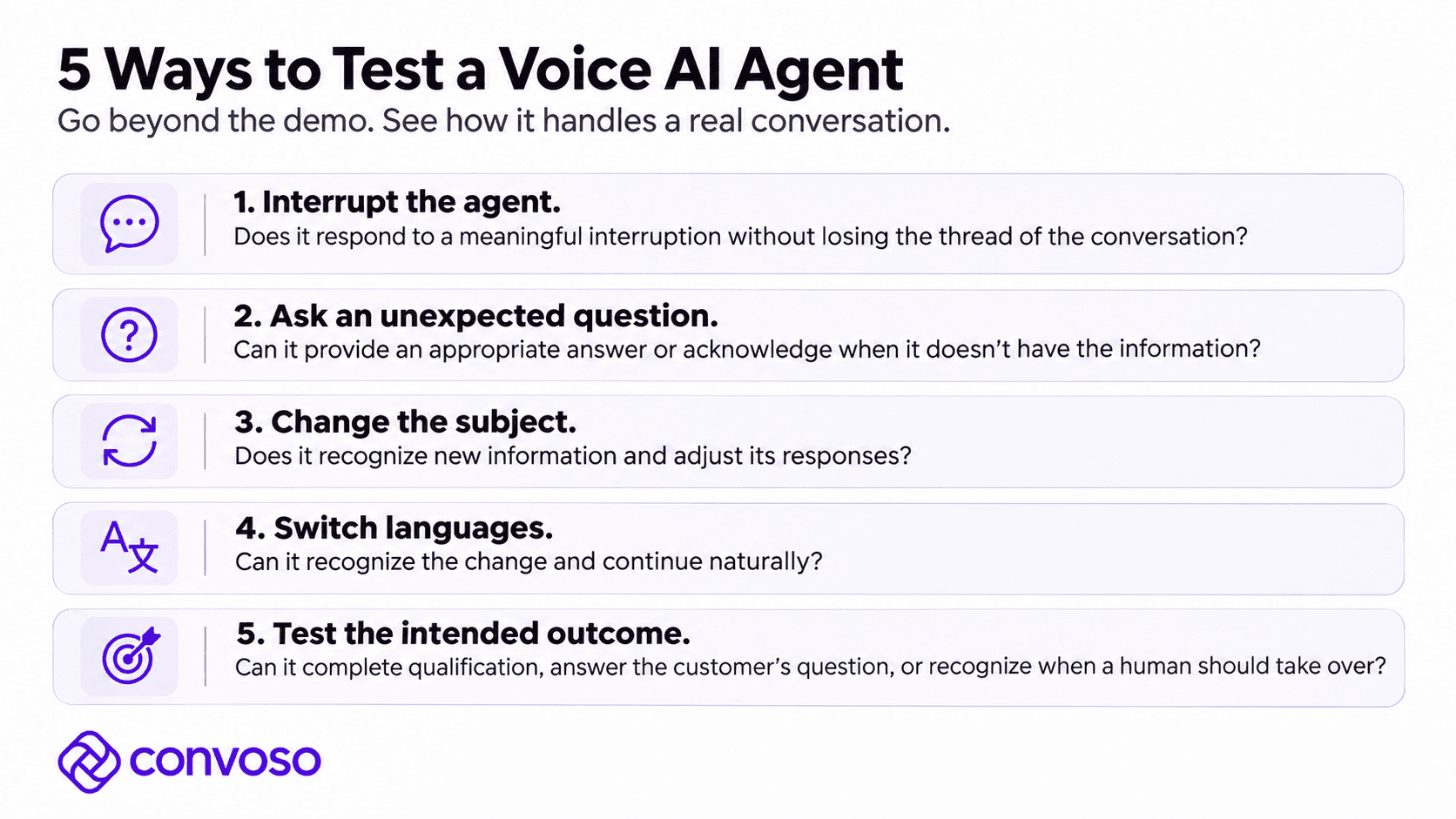
These tests should reflect the organization's actual use cases, whether that's lead qualification, appointment scheduling, customer inquiries, or call routing.
Businesses should also assess the results of those conversations. Did the agent gather accurate information? Was the customer able to accomplish what they needed? Did qualified prospects reach the appropriate next step?
Those outcomes ultimately matter more than how impressive the demonstration sounded.
The real test is the conversation
A realistic voice can make a strong first impression. But the more meaningful measure is whether an AI agent can navigate real customer interactions and help callers reach the right next step.
One of the best ways to evaluate that capability is to have a conversation with the agent yourself.
Put Convoso Voice AI Agent to the test
Experience how Convoso Voice AI Agent responds to questions, interruptions, and changes in conversation in real time. Call 855-CONVO-AI (855-266-8624)
Explore Convoso Voice AI Agent →
Frequently asked questions about voice AI conversation quality
A conversational voice AI agent can recognize spoken input, interpret its meaning, and respond in a way that reflects the context of the interaction. Natural speech, response speed, interruption handling, and the ability to adapt to unexpected questions all contribute to conversational performance.
Sub-second response time means the AI can generate a response in less than one second under the conditions used to measure its responsiveness. Low latency can make exchanges feel more natural by reducing pauses, although response accuracy and contextual understanding remain essential.
Some voice AI systems can recognize when a caller changes languages and switch without requiring a new call or manual selection. Convoso Voice AI Agent supports multilingual conversations, including switching between English and Spanish during an interaction.
Businesses should test realistic qualification conversations, including unexpected answers, objections, interruptions, and requests for clarification. Beyond conversational quality, they should assess whether the agent collects accurate information, identifies qualified prospects, and completes the appropriate next step.
Schedule a demo
Supercharge your sales with our AI-powered contact center platform.